The Late Registration Dilemma ⏰

Here we go again - complaints about hotels! 🤯
You secured a hotel block at competitive rates. As expected, it closed ~30 days before the event.
Soon after, exhibitors and delegates begin questioning why they can't book a room through the official website. While it’s tempting to say “Well you should have booked earlier” that response misses the point. They haven’t actually done anything wrong.
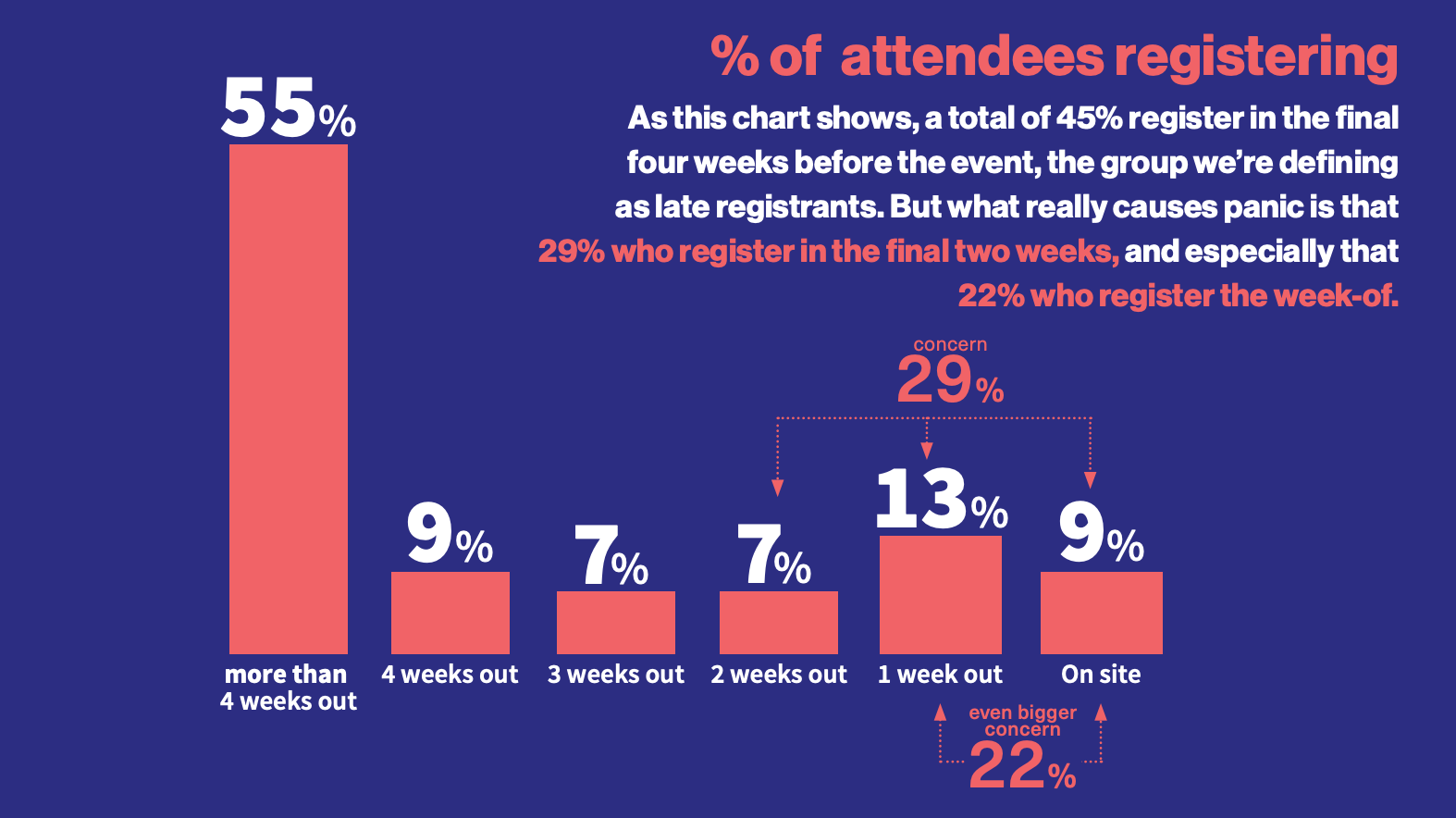
As presented by Maritz, only ~55% of delegates register more than 4-weeks out, meaning 45% of delegates are trying to book hotels after the official hotel block has closed.
That’s a real problem that can’t be ignored. Events are missing out on hotel commission, and more importantly, failing to meet delegate needs.
So how do those late registrants book hotels? 🤔
No matter which direction the registrant heads in, their initial perception of the event isn't going to be positive. They need a hotel for the event, and they're not being offered one by the organiser. Instantly their perception is tainted.
So what do late registrants do?
Search via another website 👀
Yes, they'll probably look elsewhere, but they shouldn't really have to, and the reality is the outcome probably won't change.
Websites won't magically offer low rates next to the venue. Demand is high, supply is low, so rates will increase - often above the delegate's travel policy limit.

Search in a different areas 📍
Yes, some will do so if they can be bothered, and if they know how.
For many people, seeing no availability is enough to switch them off entirely. They move on to another event, or decide they’ll attend next year instead. They’re not inclined to trawl multiple websites or hunt across different neighbourhoods to find suitable accommodation.
Others are willing to dig a little deeper, but they lack the local knowledge to do it confidently. Most events attract international visitors who don’t know the area. They’ll search using the venue name, scan the first few hotels and then panic if the rates are higher than their policy permits.
In theory, the answer is simple: increase the distance radius to find hotels in policy, in practice, it rarely is quite that simple.
A low-cost hotel three miles away might be a five-minute train ride or a one-hour walk. Without knowing local transport, or traffic patterns, that distance is meaningless. Finding out requires yet more research, and by that point, many have simply reached their limit.

Don't stay overnight 🚗
“The hotels are too expensive — I’ll just go for the day”
It happens all the time, and it’s not good for anyone. Attendees are up at ridiculous hours, arriving late, cramming meetings into a shortened window, and leaving early to beat the traffic.
The result - meetings where people aren't really listening because they're tired and they're in a rush. That's not good for anyone..
Just don't attend ❌
Highly likely, especially when registration is free. There’s nothing to lose.
Even with paid events, non-attendance is still a risk. Travel and accommodation costs are often checked before registering, particularly by those who’ve been caught out before. Paying £500 to secure a place, only to realise you can’t book accomodation within budget, leads to awkward conversations with your manager, or hours spent trying to cut costs. Neither is appealing, and when the effort outweighs the value, people quietly disengage.
So how can you avoid these issues in the first place? There are a few strategies I’d recommend.
Book the right venue on the right dates 📆
One of the first pieces of advice we give clients is to consider hotel availability when selecting dates and venues.
We’ve all seen it happen: a major B2B event booked at the same time as a Grand Prix, and let’s be honest, the Grand Prix is always going to win.
The solution? Make hotels a key factor in your venue sourcing strategy. Getting ahead of risk early can save a lot of headaches later.

Don't treat hotels as a tick box exercise ✅
Yes, you can earn commission from hotels, but that shouldn’t be your only motivation.
The real focus should be on getting hotel arrangements right, because they can make the difference between a successful event and a flop. It matters, and it needs to be built into your pre-event strategy from the very beginning.
A tip - if you ever hear someone say "have we got the hotel link for the website?" it probably means you need to go deeper. Doing hotel booking well involves much more than just adding a link to a website. It's a strategic play that requires energy and business priority....

But what does focussing on hotels really look like?
Get strategic with sourcing 🕵️♀️
Some event owners understand the importance of hotels, and their scale allows them to bring in dedicated sourcing expertise. Good in-house hotel specialists are worth their weight in gold. They know how to secure the right capacity, at the right rates, in the right locations, and with the right commercial terms. They handle hotels firmly but respectfully, creating win-win outcomes.
For event owners without the scale for in-house hotel specialists, partnering with the right third-party is crucial.
The right partner will dig deep to understand every aspect of your event. They’ll research the local area, secure low rates in locations you may not have considered; identifying hotels slightly further away but well-connected by high-speed transport lines, cutting travel time dramatically. They'll find hidden gems your delegates will love, and importantly, they'll plan for the post-block period when ~45% of your registrations take place. There will never be a time you are not selling rooms at rates your delegates are able to book per their company travel policies.
Get your shop-window in order 🛍️
The quality of your hotel proposition reflects the quality of your event.
Typically, you won’t control the hotel proposition yourself, it’s usually outsourced to a partner, which makes choosing the right partner critical.
Anyone can provide a link to a hotel booking page, offering either your contracted rates or live availability. But if you want to maximize bookings and deliver a great customer experience, you need to demand more and ask the right questions during partner selection:
1. Does the technology recognise delegate behaviour? ⏰
We know that ~45% of delegates register after hotel blocks close. Your partner must offer a comprehensive post-block capability that provides choice and value right up to the event. They should get creative, providing cost effective, high quality options that aren't obvious but really suitable for delegates who are on a tight budget.
2. Does the technology cater to international visitors? 🌍
If your delegates come from multiple countries, your booking solution must support their languages and currencies. If it doesn’t, it sends the wrong message to your delegates.
3. Does support cater to international visitors? ❤️
Overseas delegates will require support in different time zones. Restricting calls to 09:00–17:00 local time isn’t good enough. Support should be 24/7/365.
4. Does the technology look and feel good? 🌟
Remember, delegates are booking through your brand, so the technology reflects on you. It should be intuitive, attractive, and easy to use. If it isn’t, ask yourself why are you using it?
5. Are delegates empowered to make a decision? 🧐
Delegates need clear information before booking. Here’s what they expect:
- All options clearly displayed ✅ – Room types, board options, cancellation policies, and payment options. They want choice. Not everyone wants the default double room with breakfast, free cancellation; some may prefer a single, non-refundable, room only because it’s cheaper. Make sure your partner offers all options.
- Confidence in the rate 📈– delegates assume the official event website offers the best price. If it doesn’t, they won't book, or they will but they'll then be frustrated when they find out they've paid over the odds.
- Hotel quality based on reviews, not stars 👍🏻– a 2-star hotel can be great, and a 5-star awful. Reviews matter more than ratings, so make sure your partner shows them.
- Accurate travel times ⌚️– distance from the venue is meaningless. Delegates need travel times to judge convenience.
- Clear terms and conditions 🔎– everything should be simple and transparent. Hidden fees, buried cancellation charges, or confusing Ts&Cs are a big no-no. If you can't understand something, your delegates won't. Test your partner's solution.
Choosing the right partner and technology isn’t just about getting a hotel booking link. It's about recognising the impact hotels can have on an event's success - and pro-actively getting on top of it.
Done well, hotels can be a positive asset for your event. Done badly, they are a huge risk.
The views expressed are my own and do not represent those of my employer. Any references to companies, products, or technologies are based on publicly available information and personal opinion, and should not be interpreted as endorsements.
Member discussion