Why is event registration broken? 💔

Yes, i've made a bold statement to draw you in. I know registration isn't always broken, sometimes it's great, but often, let's be honest, it's shockingly bad.
Picture this. You’ve invested heavily in marketing to drive visitors to your event website. Around 50% leave without clicking a thing (that's the norm). And the ones who do stay? They’re immediately confronted with a registration form asking them to complete 24 fields on a single page.

That's exactly what I found when registering for a $500 fee event from a highly reputable event organiser.
When we’re filling out online forms, we all have that inner voice running, usually not a positive one. So here’s my unfiltered inner monologue when I went through those mandatory fields.
-
Email - fair enough, valid ask
-
Title - Why do you need it?
-
First Name - fair enough, valid ask - albeit my email has it in there
-
Surname - as above
-
Job Title - Get it yourself from my LinkedIn
-
Company - Get it yourself from my LinkedIn or email domain
-
Address 1 - Why do you need it? you can see where I am
-
Address 2 - as above
-
Post Code - as above
-
State - as above
-
Mobile - Why do you need it? you're making me nervous
-
Will I have a service animal - Should I need to tell you?
-
Do I have a wheelchair - Should I need to tell you?
-
How will I travel to the event - No idea, and why do you care? get the info from someone else.
-
What type of company do I work for - Get it yourself, it's on my LinkedIn
-
What products/services am I interested in learning about - Figure it out using my LinkedIn and social interactions.
-
What category of people does my organisation teach - you know my company, figure it out yourself from that.
-
My job function - Get it yourself, it's on my LinkedIn
-
Problems i'd love to solve - Figure it out using my job title, LinkedIn profile and social interactions.
-
My role in purchasing decisions - Figure it out using my job title and LinekdIn profile.
-
The number of employees in my organisation - Get it yourself, it's on my LinkedIn
-
My Linkedin URL - Maybe a fair ask, but if you have my name and email, you may not even need it to find it yourself.
-
Will I subscribe to a newsletter - no, you're going to bombard me
-
Will I accept the Ts&Cs - do i have a choice?
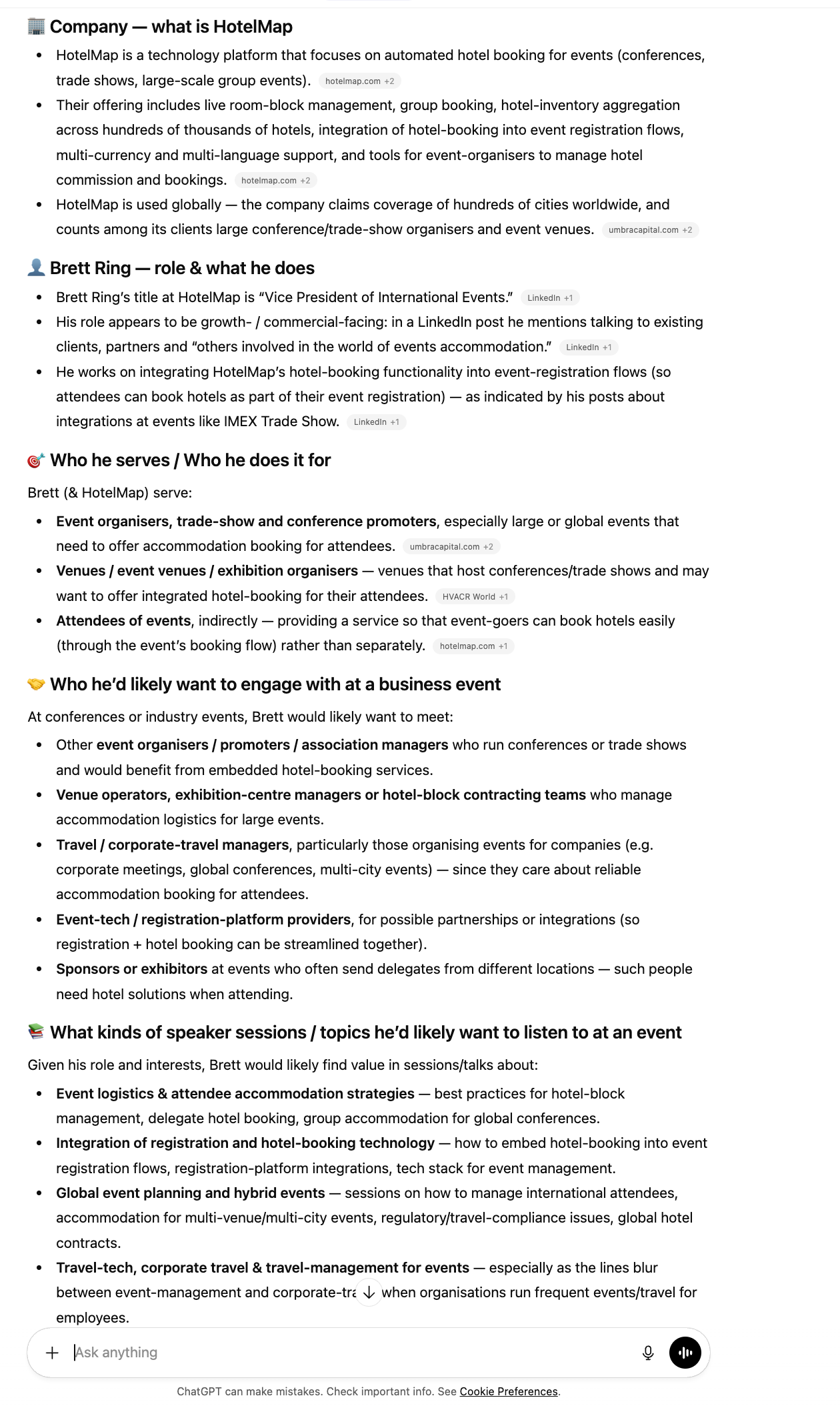
The reality is we all use tools like ChatGPT or Gemini, so we know exactly what’s possible. We know how fast technology can understand us, complete tasks, and remove friction. For example, I just asked ChatGPT a simple question:
"Find Brett Ring of HotelMap. Study everything you find about him and tell me what he does, who he does it for, what he's interested in, who he would want to engage with at a business event and which speaker sessions types he'd be interested in?"
The answer I got back was detailed and instant, so why, am I being asked for the same information during event registration?
So why are we still seeing long, complex registration forms? I don't have the answers, but I do have some questions to spark discussion.
Is the technology just not there?
I’m not close enough to registration tech to know the definitive answer. What I do know is that there are plenty of companies out there who are clearly very capable, innovative, and forward-thinking. So the capability is definitely there. A few of those companies are below:
Swoogo - RainFocus - Bizzabo - CrowdComms - VFairs - Cvent - Accelevents - Stova - Whova - ExpoPlatform - EventsAir - IDLoom - Emendo - Zuddl
Are events being too loyal to tech providers?
Maybe. Events professionals are incredibly busy, so it’s easy to stick with what you know. But the problem is that what’s familiar isn’t always what’s best for your attendees, and staying still means you can fall behind quickly.
My sense, though, is that the more innovative players in the market are doing a great job of raising awareness and pushing events teams to rethink their sourcing strategies.
Has the growth in "Event-Platform" slowed us down?
There seems to be a shift happening, from specialised event-tech tools towards the all-in-one, one-stop-shop platforms. But in making that jump, are some event-tech providers doing everything well, yet not doing anything exceptionally? I don't know...
We’ve seen this before in corporate travel. When online booking tools arrived, they promised flights, hotels, rail, and expenses in one place. Convenient, yes, but each feature lacked the depth and quality of the specialist tools they replaced. It took years for the industry to even come close to delivering the “best of both worlds,” and arguably, many would say it still hasn’t fully arrived.
So is the events industry heading down the same path?

Is the growth in "Self-Serve" a problem?
Event teams aren’t experts in online conversion, yet they’re often the ones building registration forms through self-serve platforms. That creates a real challenge.
So as event-tech providers, we should be asking ourselves:
- Should we be more opinionated about what we do and don’t allow in self-serve tools?
- Are we giving event teams the right training to make good decisions?
Because honestly, if I try to build a form with 25 fields, don’t let me. Make it difficult. Add friction. Force a conversation about best practice.
Sometimes the most helpful thing a platform can do is protect users from themselves.

Is the movement away from "per registrant" commercials impacting conversion?
I’ve heard that many event-tech providers are moving away from per-registrant commercial models. And while that shift makes sense, it does raise a question:
if revenue is no longer tied to the number of registrations, does the incentive to optimise and increase registrations start to weaken?
My gut says no. Event-tech providers understand that if they lose focus on their clients’ objectives, those clients will simply walk away. The commercial model per registrant or otherwise, probably doesn’t change that. Still, it’s an interesting question worth thinking about.
Is it a non-issue?
Maybe it isn’t a problem. Maybe the trends we see in e-commerce don’t map to event registration.
My feeling is that there no doubt are differences, but it feels a bit naïve to assume we’re entirely unique and that the lessons from e-commerce don’t apply to us. After all, the same people buying trainers online are registering for our events. They don’t suddenly switch mindsets just because it’s a different product or service.

The views expressed are my own and do not represent those of my employer. Any references to companies, products, or technologies are based on publicly available information and personal opinion, and should not be interpreted as endorsements.
Member discussion